
Case Study: Fixing Low-Density Hair Transplant & FUE Scars
Client History
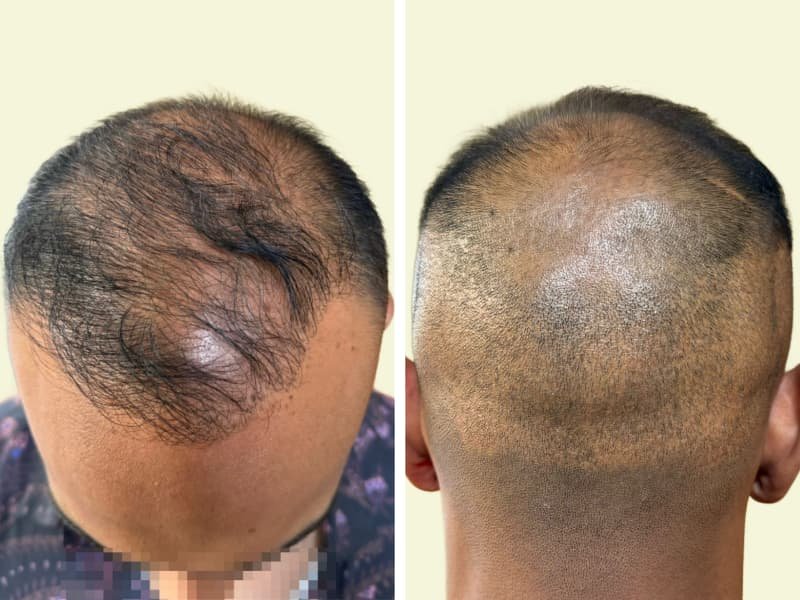
The client had previously undergone an FUE (Follicular Unit Extraction) hair transplant to restore a fuller appearance after progressive hair thinning. However, even after waiting 12 months for the final results, he was left with low density across the scalp and visible donor-area scarring.
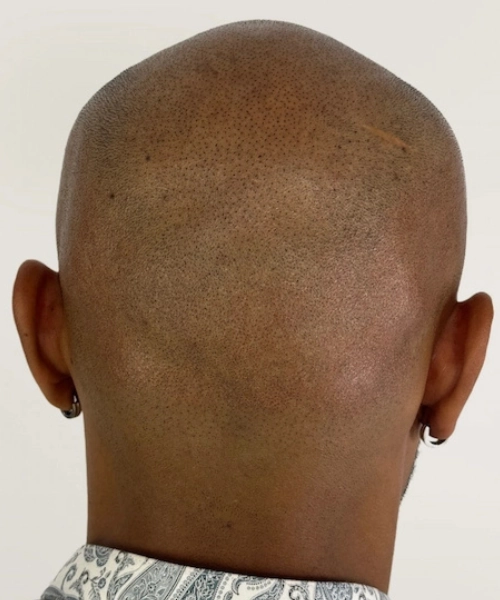
He found himself in a difficult position. Growing his hair longer made the thinning more obvious, while shaving his head exposed multiple FUE scars in the donor area.
This led to the constant use of caps and a noticeable drop in confidence.
While searching for a solution that did not involve further surgery and offered a more reliable long-term option, he discovered Scalp Micropigmentation (SMP).
Why He Chose SMP After Hair Transplant
The client realized that SMP could:
- Visually increase density across the transplanted areas
- Create the appearance of a one-day-old shaved, fuller hairstyle
- Camouflage the FUE scars in the donor area
Most importantly, he was looking for a solution that would allow him to maintain a clean, fuller look 24/7.
He didn’t want to rely on caps and wanted the confidence to play sports, swim, go to the gym, attend social events, and go about his daily life without constantly thinking about hair loss or low-density concerns.
Consultation Findings & Treatment Plan
During the in-person consultation, we carefully assessed his hair density, thinning pattern, skin tone, recipient-area scarring and skin thickening from the transplant, and the visibility of FUE scars in the donor area.
Planned Approach
- Top density enhancement: 3–4 SMP sessions
- FUE scar camouflage: 2–4 SMP sessions
- Custom pigment dilution, needle selection, and density planning based on how the skin responds after each session
Goal: To create a natural 1–2 day shaved shadow look with even blending across all zones.
SMP is customized at every stage based on skin condition, scarring, pigment retention, and how the scalp responds between sessions.
SMP Density Build-Up Sessions (Top Area)
Session 1
- The client arrived with a clean shave one day prior, allowing clear identification of blending zones.
- The hairline and side profiles were redesigned and approved before starting.
- A light initial layer of impressions was applied from the hairline to the crown.
- Low density was maintained using appropriate pigment dilution.
- Detailed aftercare instructions were provided.
- The next session was scheduled after 14 days.
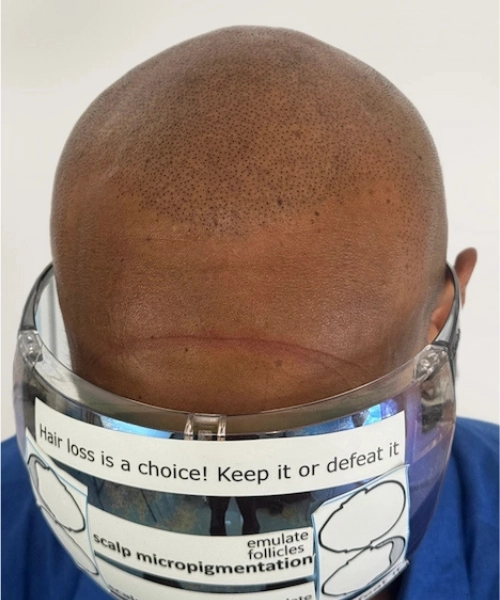
Session 2
- We assessed how the pigment from Session 1 had settled into the skin.
- Adjustments were made to pigment dilution, needle size, and density planning based on retention.
- Density build-up was carried out with controlled blending into the sides and back.
- Special care was taken around the donor area due to existing scarring.
- A 30-day gap was maintained before Session 3 to allow proper settling.
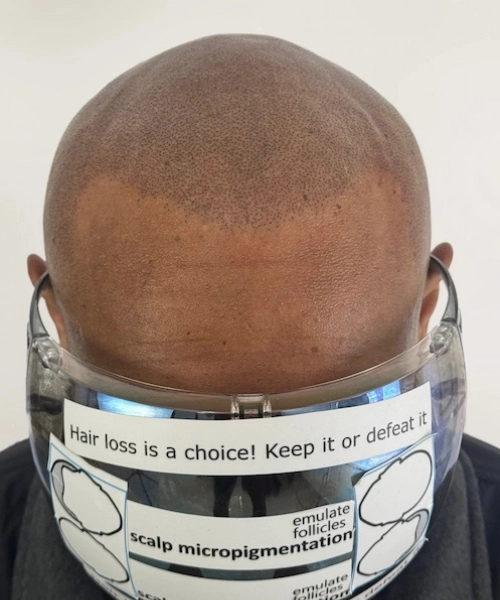
Session 3
- A detailed evaluation of pigment retention and skin response was carried out.
- Further density was added to enhance overall fullness.
- Blending was refined to ensure a natural transition across all areas.
- Final adjustments were made to the hairline, crown, and transition zones.
Outcome (Top Area)
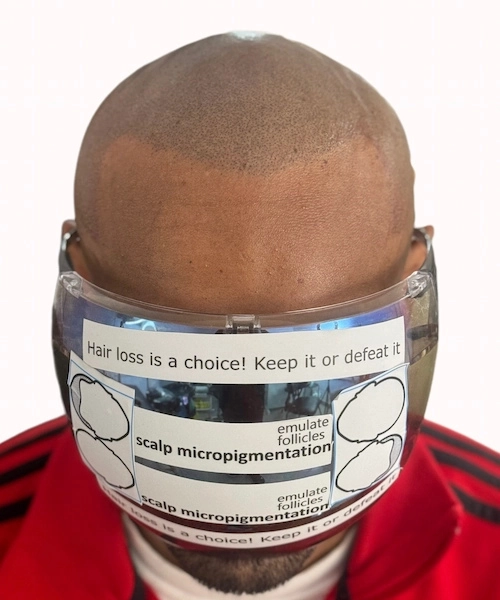
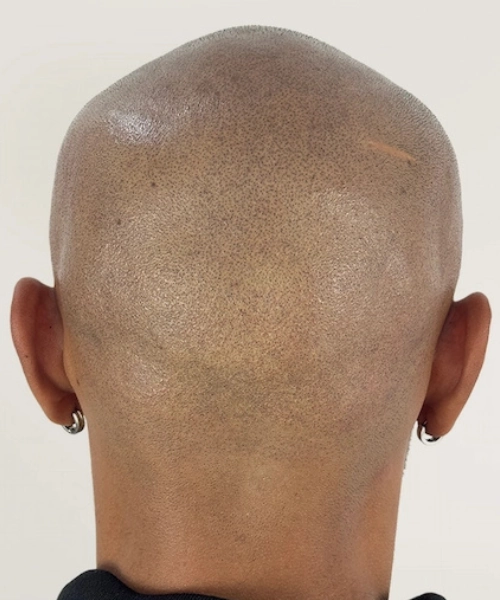
The client achieved the appearance of a uniform, dense, one-day-old shaved hairstyle with natural transitions across the scalp.
FUE Hair Transplant Scar Camouflage
Scar camouflage was treated as a separate SMP process due to the unique nature of scar tissue.
Scar Camouflage Consultation
We assessed the scar size, distribution, texture, and contrast against the surrounding skin. Based on this, a gradual layering approach was planned, with sufficient healing time between sessions to ensure proper pigment retention.
Scar Camouflage Session 1
- The area was clean shaved for full visibility.
- Custom pigment dilution and needle selection were used specifically for scar tissue.
- An initial layer was applied with slight blending into the surrounding areas.
- A 30-day gap was allowed to ensure proper healing and pigment retention.
Scar Camouflage Session 2
- We reviewed how the pigment had retained within the scar tissue.
- Density and tone were adjusted carefully to achieve optimal camouflage.
- Care was taken not to overwork the scars.
Outcome (Scar Area)
Two sessions were sufficient to significantly reduce the visibility of FUE scars when the head is shaved.
Final Result
After completing the sessions:
- The low-density transplant appearance was effectively corrected
- Donor-area FUE scars were successfully camouflaged
- The client now maintains a clean, classic 5 o’clock shadow hairstyle with confidence
He no longer needs to conceal his scalp with caps or rely on longer hairstyles or hair fibres.
Beyond the visual transformation, the biggest change was in his confidence. He no longer feels the need to hide his scalp or worry about how his hair looks in different lighting or everyday situations.
SMP provided a non-surgical, long-lasting visual solution to both transplant density limitations and donor scarring.